# 🐷 PIG — Prime Intellect Growth
**An open-source, agent-native CRM for two-sided AI-compute companies.**
[](./LICENSE)
*Self-hostable. Auditable. Built for teams that buy GPU capacity on one side and sell it on the other.*
---
## Why this exists
A company that aggregates GPU capacity and resells it does not run one pipeline.
It runs two, and its business is the spread between them.
Today that spread is usually managed in a spreadsheet with a margin calculator
in column K, a document of supplier terms, and a general-purpose CRM that has
no idea what an H100-hour is. Salesforce, HubSpot and Attio model a single
pipeline of deals against companies. They have no concept of **inventory**, no
concept of a **commitment you already bought and are paying for whether or not
it sells**, and therefore no way to answer the question the business turns on:
> Which contracted capacity is sold, to whom, at what margin — and what is idle
> right now?
PIG is one ledger that knows the domain. The load-bearing table is
[`allocations`](./packages/db/src/schema/allocations.ts), which joins a
`capacity_commitment` (what you bought, at a known cost) to a `demand_deal`
(what you sold, at a known price). Margin, utilisation and idle capacity all
fall out of that one join. Everything else is plumbing that keeps the ledger
honest.
**Cost is charged against the full commitment, not only the hours that sold.**
Unsold hours are already paid for. Charging only the allocated share reports a
healthy margin on a block that is losing money, which is precisely the failure
PIG exists to prevent. There is a test pinning it.
## Who it is for
PIG models three teams, because two-sided compute companies have three
constituencies competing for the same scarce capacity.
| Team | Job to be done |
|---|---|
| **Supply** | Source, qualify, price and contract GPU capacity from providers |
| **Demand** | Sell compute and post-training; renew and expand accounts |
| **Research** | Consume capacity internally — real burn, no revenue |
Research is a first-class tenant rather than an afterthought: internal burn
competes with revenue for the same GPUs, and margin arithmetic that cannot see
it is wrong.
The team set is configurable in `packages/core/src/ontology.ts`. PIG ships with
these three because they match the structure of the company it was designed
for, not because they are universal.
## Screenshots
Captured against the current shell — header, collapsible sidebar rail, docked
Piggy — running locally on the seed plus demo book (`db:seed` and `db:demo`), so
every number below is computed by the code in this repository rather than drawn.
Records prefixed `DEMO —` are fictional; the rest are the sourced, cited seed.
Each image follows your own system theme. Both themes are shown explicitly
further down, and [the full gallery](docs/screenshots.md) has all ten pages at
1440px and 393px, in light and dark. Desktop captures are the 1440×900 viewport
rather than the full scroll height — what you see is what fits above the fold.
`node scripts/screenshots.mjs` re-shoots the set.
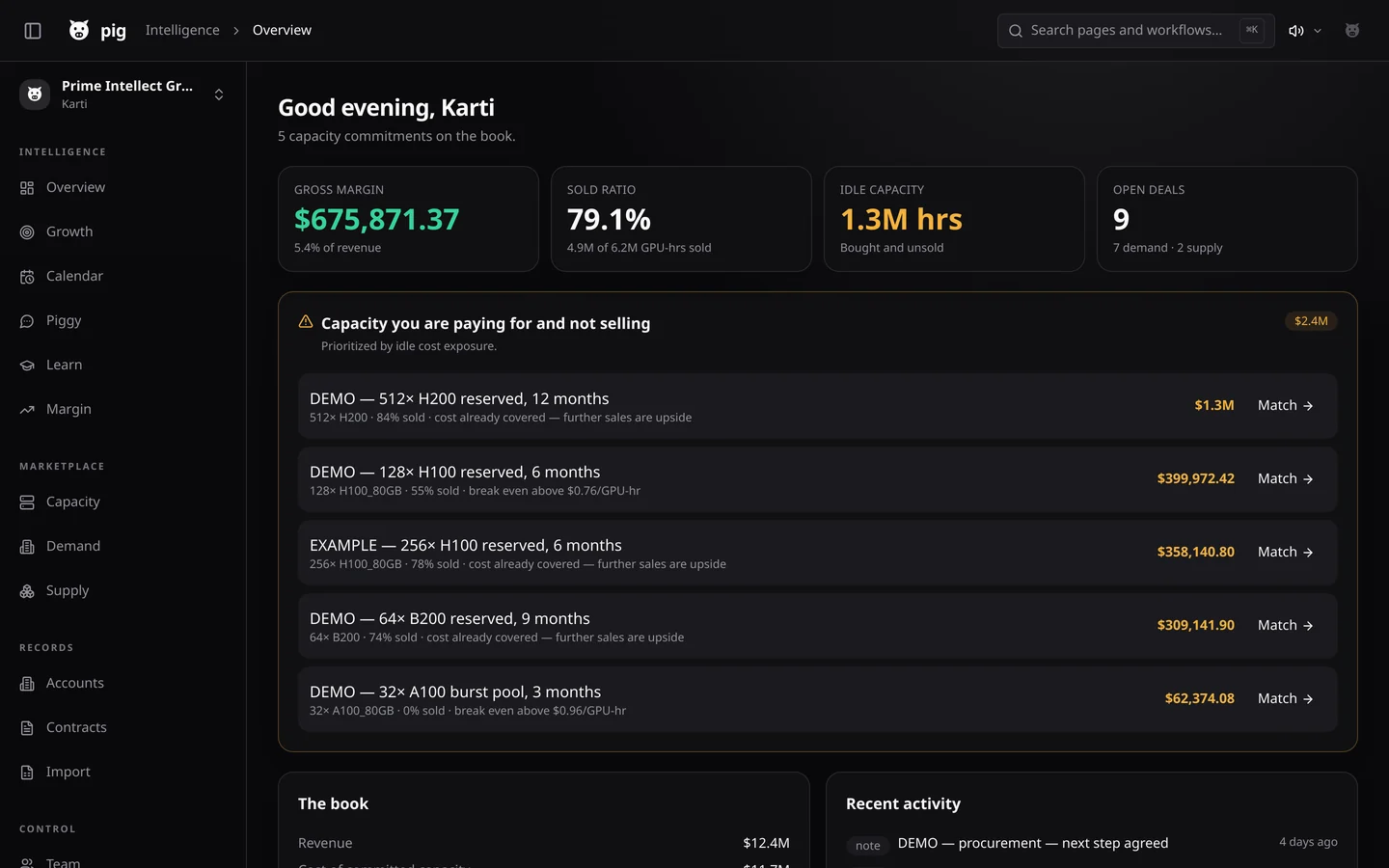
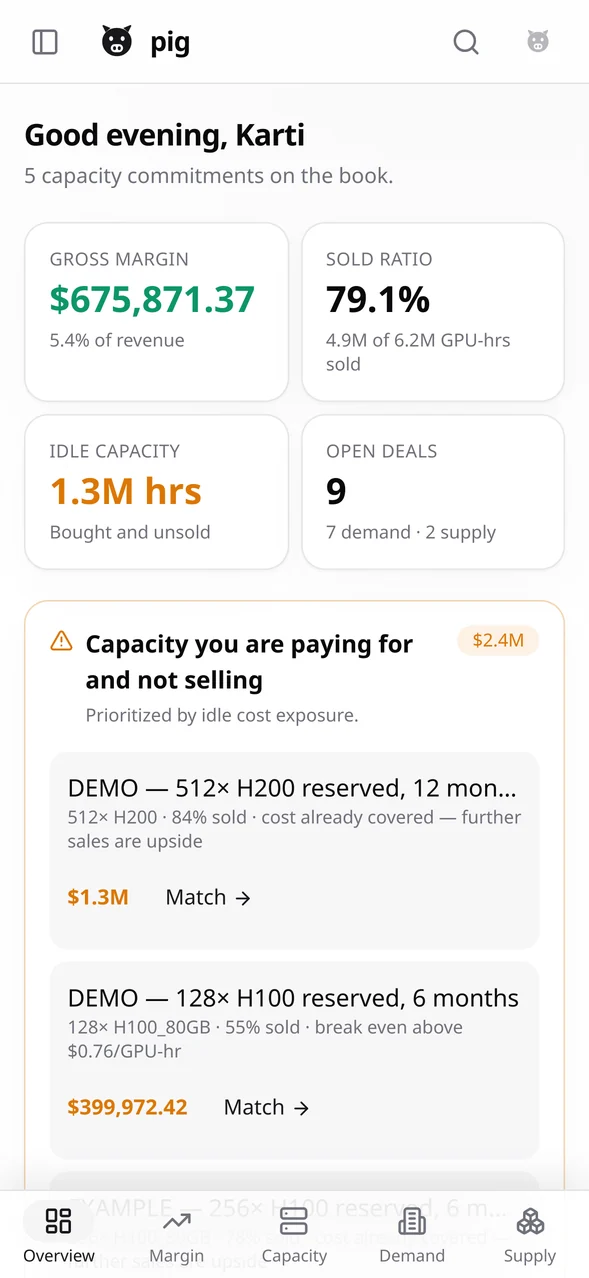
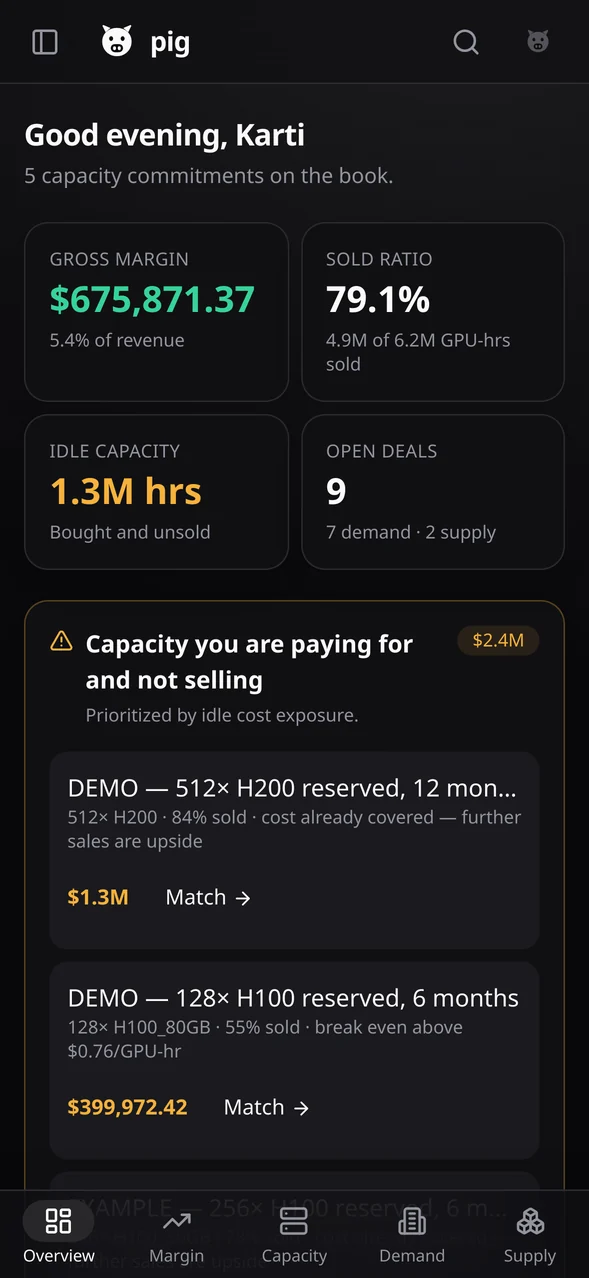
**Overview** — margin, sold ratio and idle capacity across the book, with the
commitments you are paying for and not selling ranked by cost exposure.
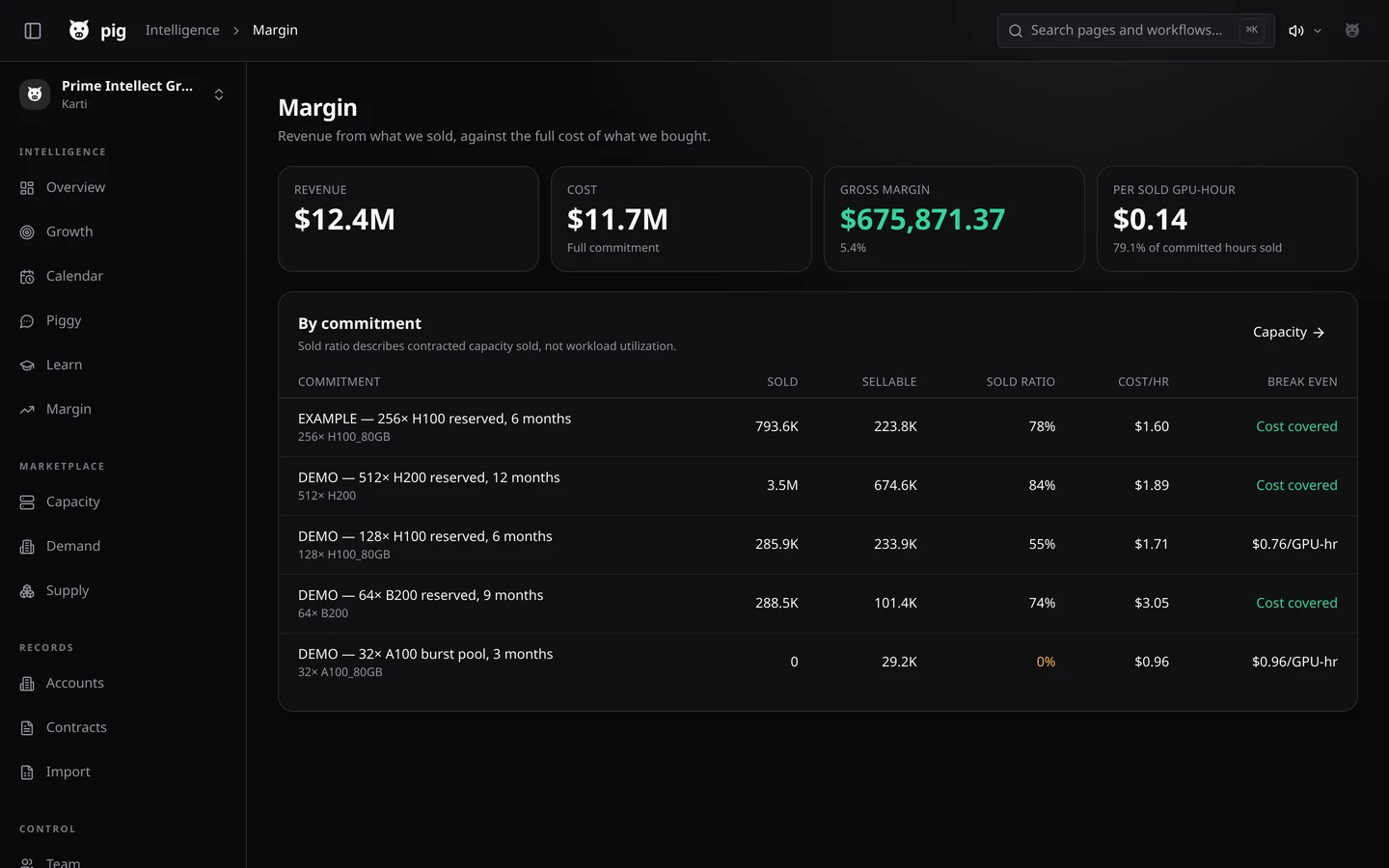
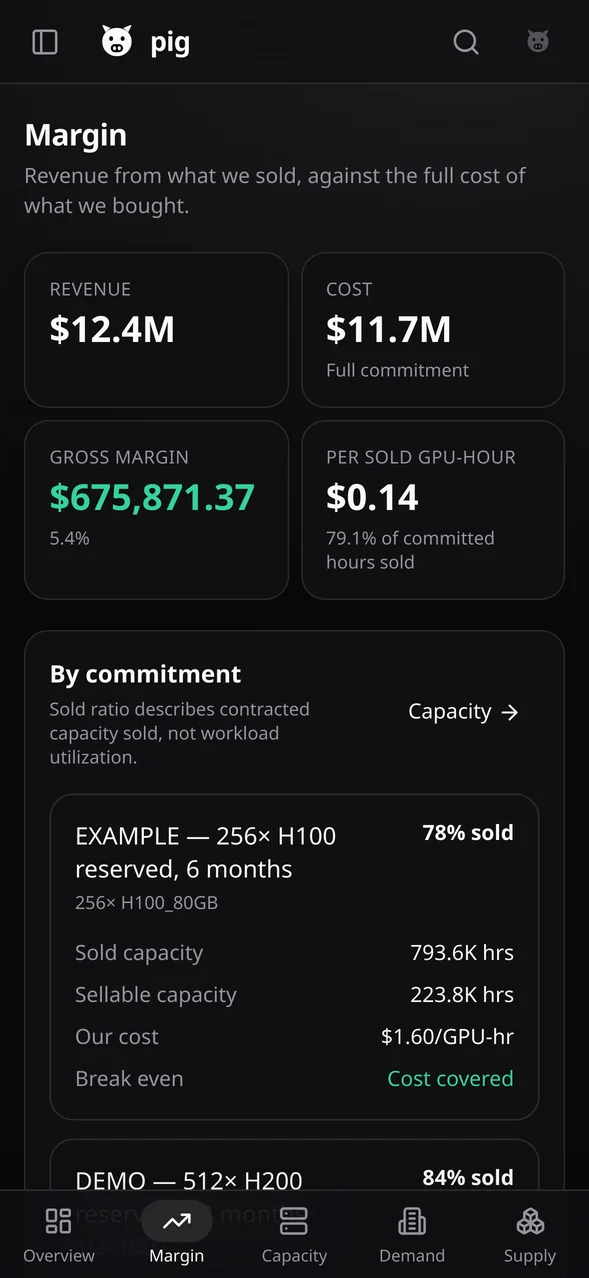
**Margin** — revenue from what was sold against the *full* cost of what was
bought, per commitment. `Cost covered` and a break-even price are the two states
that matter; charging only the allocated share of cost would report a healthy
margin on a block that is losing money.
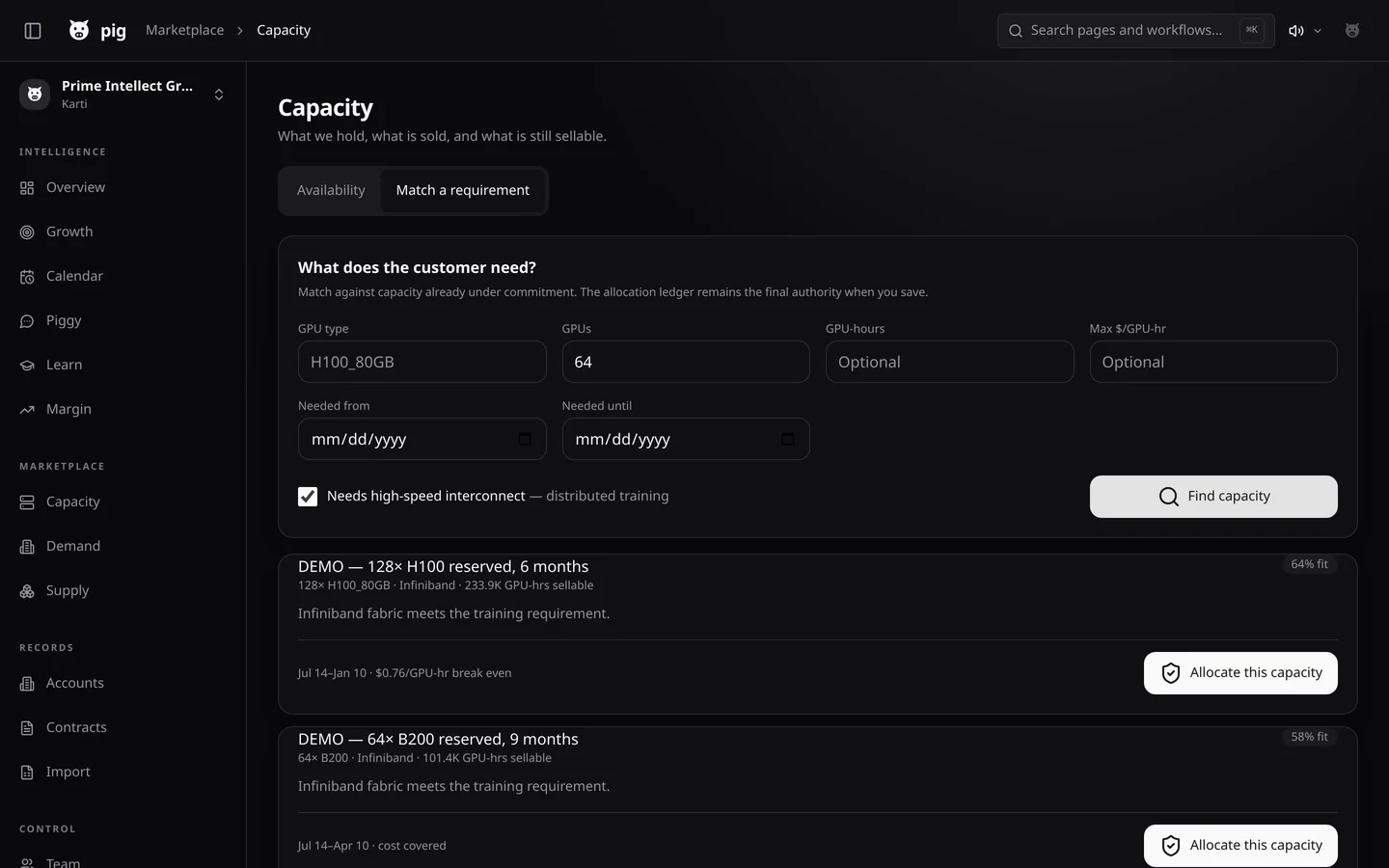
**Capacity → Match a requirement** — the matcher. Ask what a customer needs and
PIG scores it against capacity already under commitment, saying why each block
fits, and hands you straight to the allocation that records the sale.
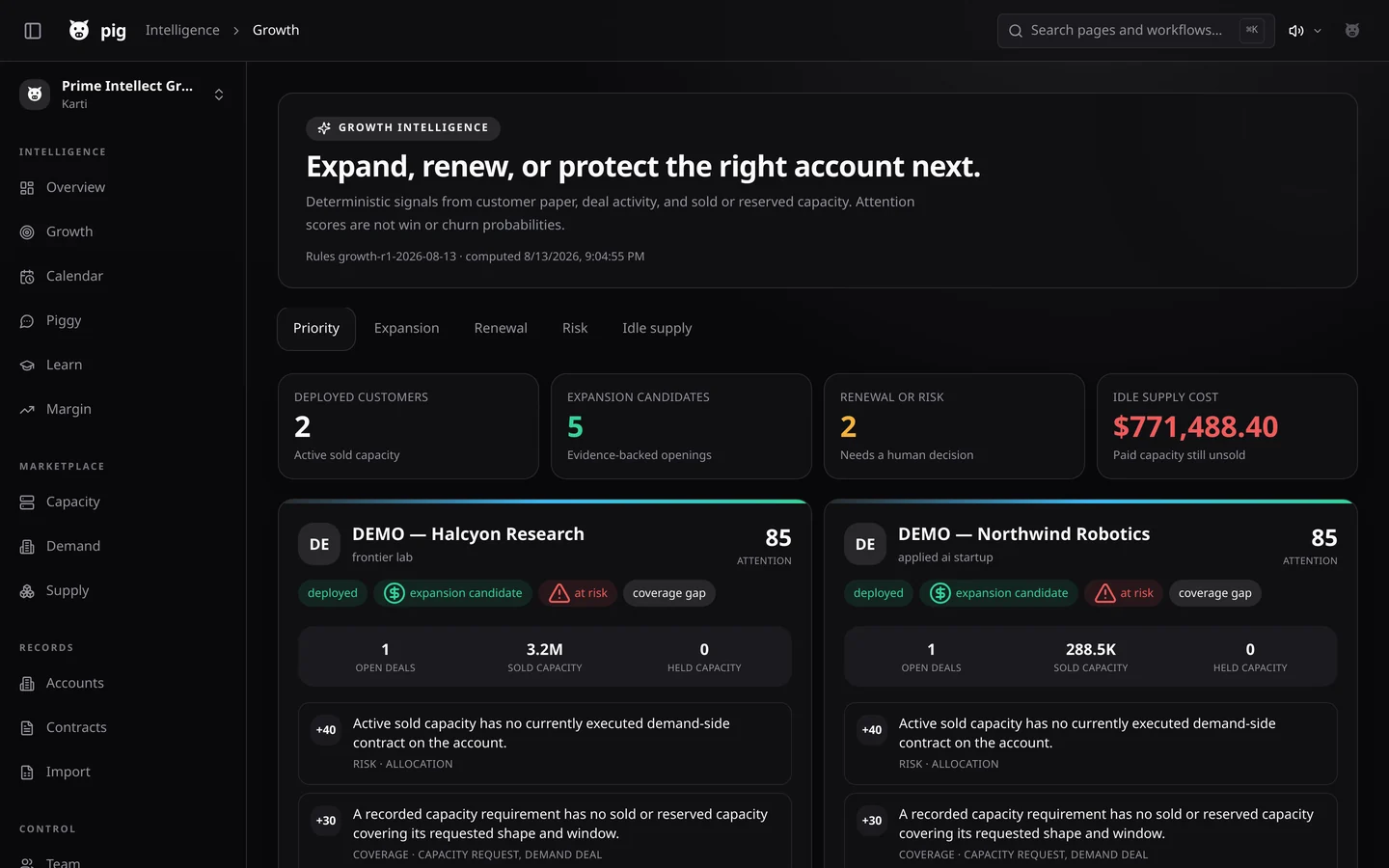
**Growth** — deterministic attention scores over customer paper, deal activity
and sold or reserved capacity. Every point is an explained signal with its
sources named; nothing here is a model's guess at a win probability.
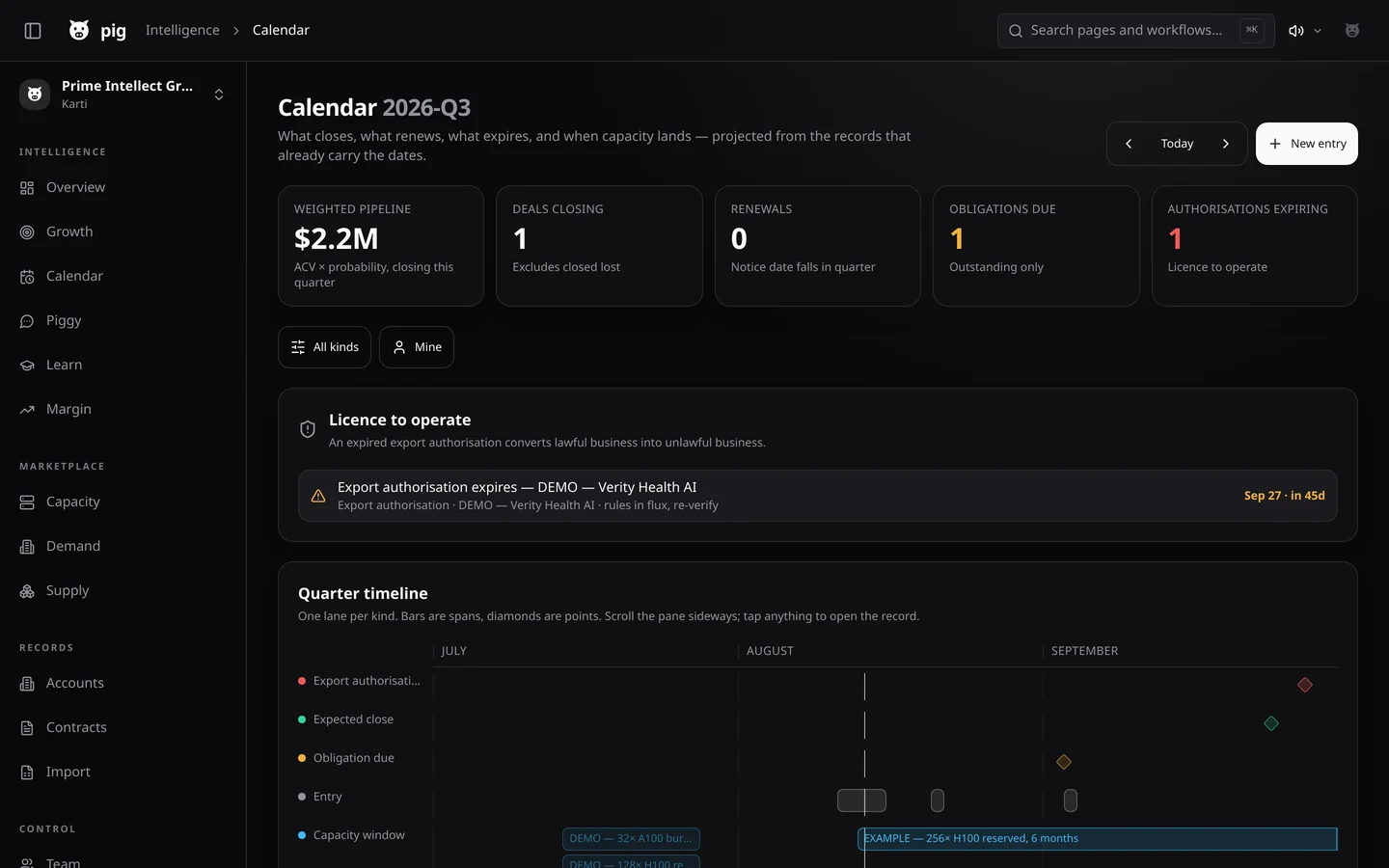
**Calendar** — what closes, what renews, what expires and when capacity lands,
projected from the records that already carry the dates. Export authorisations
expire on this timeline too, because an expired one converts lawful business
into unlawful business.
### Light and dark
Theme is a stored preference that follows a person between devices, resolved
before first paint by an inline script so dark-mode users never get a white
flash. Both tunings of the accent palette are defined in `@pig/core` and applied
as CSS variables at runtime, so there is one definition of each colour.
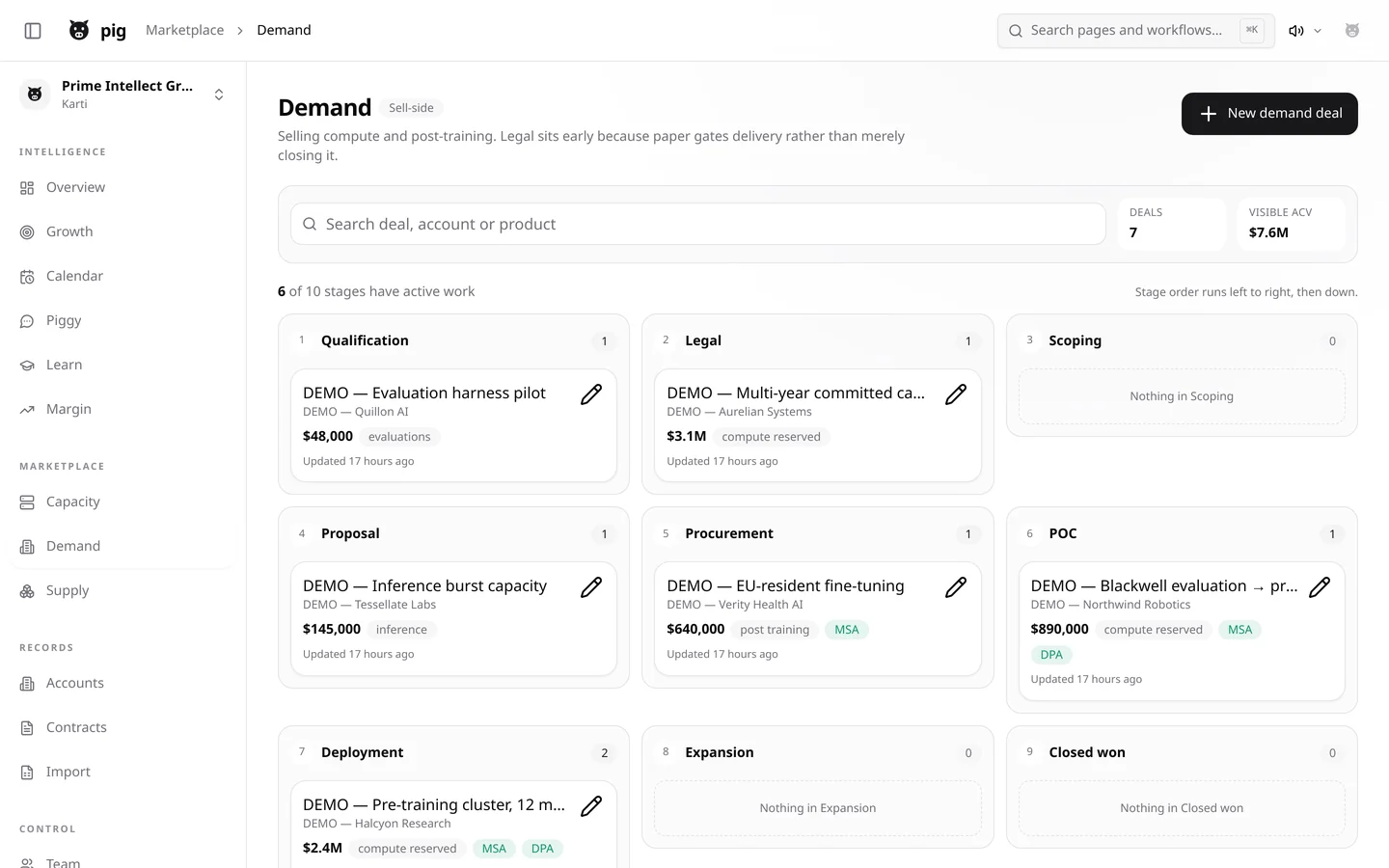
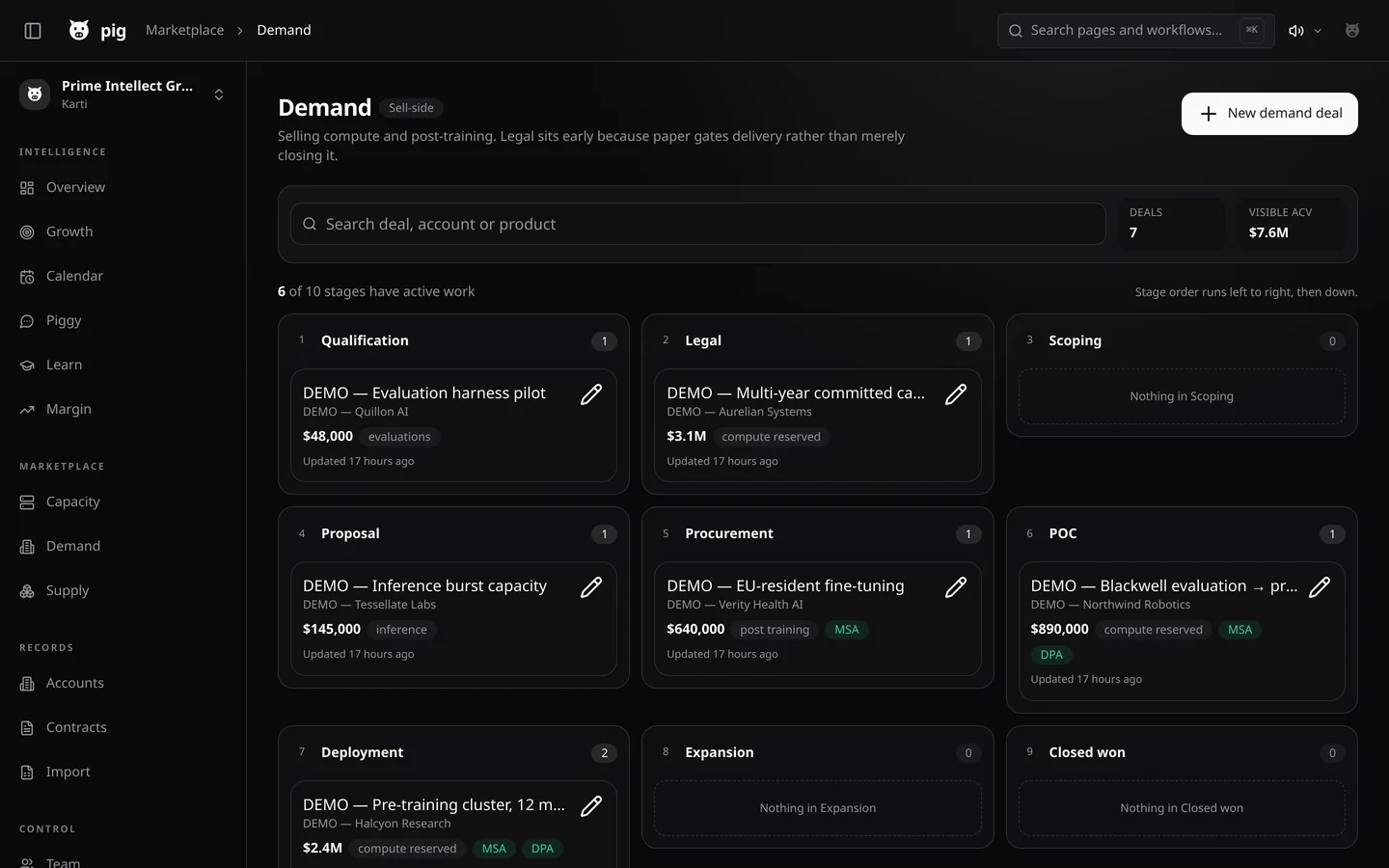
The demand pipeline, in both. Legal sits second rather than last, because MSA
and DPA execution gates delivery rather than closing the deal — most CRMs put
contracts at the end of the funnel and are wrong about it for this market.
*Light:*
*Dark:*
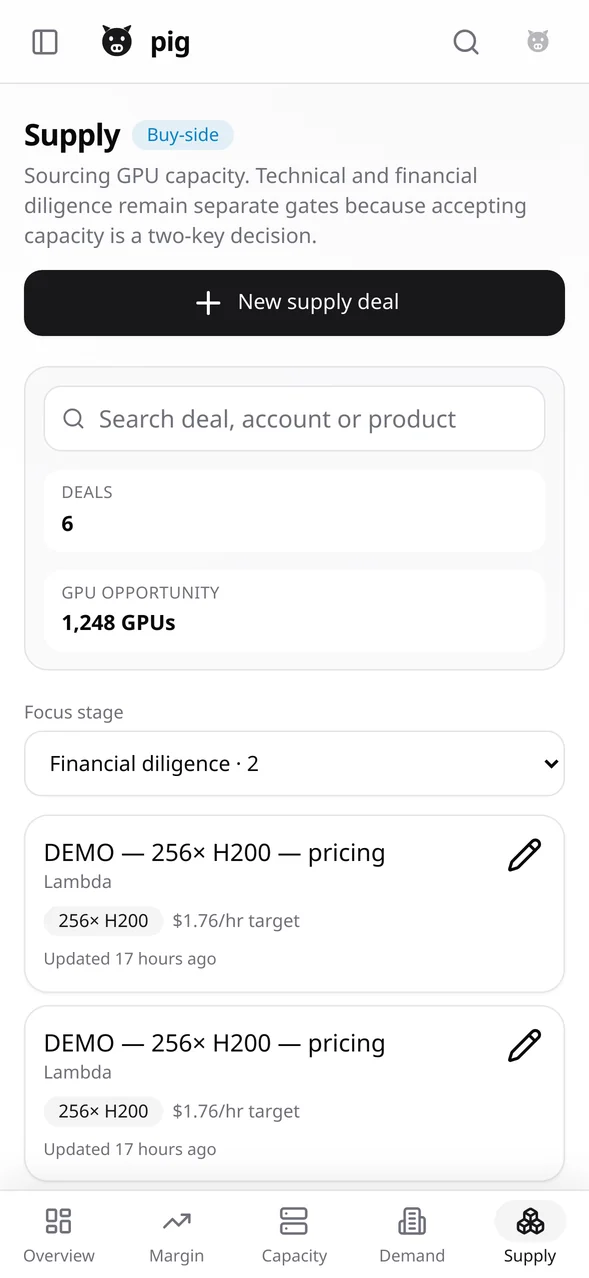
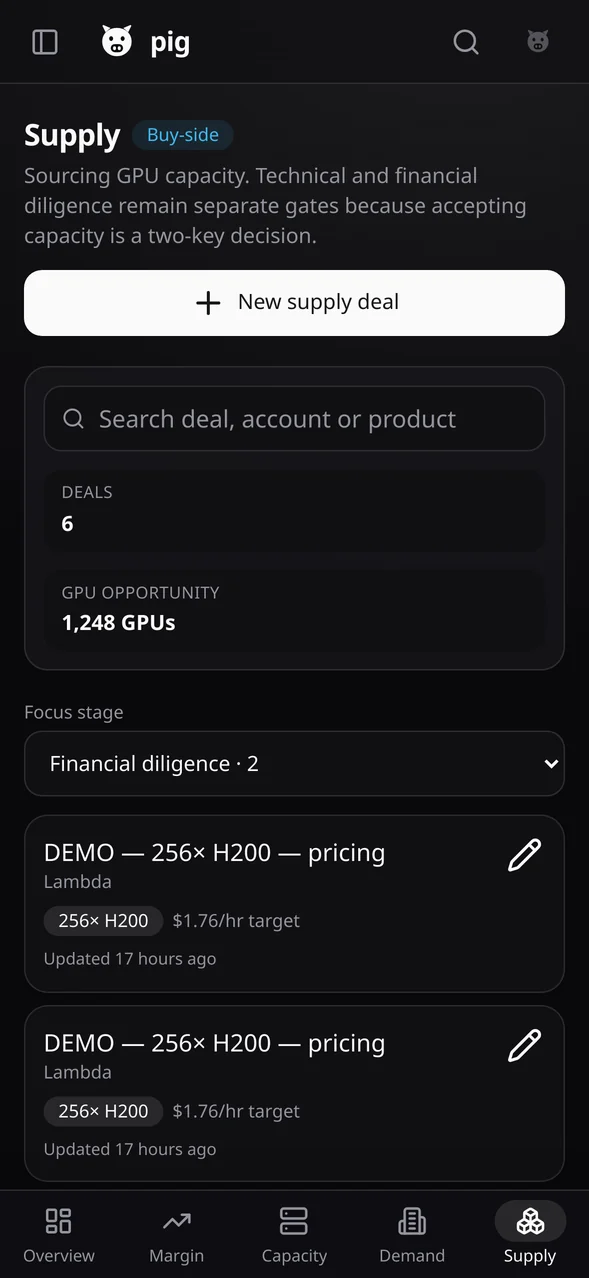
Side by side at 393px, where both tunings have to survive a smaller surface:
| Supply pipeline · light | Supply pipeline · dark |
| --- | --- |
| | |
### Mobile
PIG is responsive to 393px — the sidebar becomes a bottom tab bar, tables become
cards, and the safe-area insets are handled. It is not a native app.
| Overview · light | Overview · dark | Margin · dark |
| --- | --- | --- |
| | | |
Piggy is deliberately not pictured mid-conversation. It is off by default
(`PIGGY_ENABLED=false`, and the Compose service sits behind a profile), and
showing it answering would mean staging a transcript rather than capturing one.
What it may and may not do is described under [the agent
surface](#the-agent-surface).
## The two-sided data model
Forty-seven tables, but the shape is small. These are the ones that carry the
thesis:
| Table | What it holds | Why it is not in a generic CRM |
|---|---|---|
| `capacity_commitments` | What you bought: term, GPU-hours, cost per GPU-hour, floor and ceiling, and a **shape** (`{intervals[], quantities[]}`) | Real contracts ramp across tranches and step down at checkpoints; a single start/end/total reports availability that does not exist in the month someone wants it |
| `demand_deals` | What you are selling: ACV, product line, MSA/DPA state, stage | The paper state is a separate axis from the stage, because paper gates delivery |
| `supply_deals` | The other pipeline: sourcing a provider through diligence to live | Generic CRMs have one pipeline and call the supplier a vendor |
| **`allocations`** | **The join.** Commitment × deal × GPU-hours × window × status | This is the whole product. Margin, utilisation and idle all derive from it |
| `inventory_listings` | Market availability mirrored from the Prime Intellect API | Sync is a straight field mapping, not an ETL project |
| `capacity_requests` | What a customer asked for, whether or not it could be served | Unservable demand is the signal for what to buy next |
| `contracts` + `sla_terms` + `sla_metric_targets` + `contract_obligations` | Polymorphic over party and type — MSA, DPA, SLA, order form, capacity commitment — with negotiated SLA terms and dated obligations | The supply side negotiates heavyweight paper; the self-serve demand side runs on a reliability tier and a credits policy instead |
| `export_authorizations`, `compliance_artifacts`, `compliance_decisions` | Export-control determinations recorded **on the allocation edge**, with reasoning and rule version | US controls apply an ultimate-parent test that reaches through the corporate tree, so country of incorporation is not a valid key |
| `facts` | Every agent-derived claim, with score, band, evidence excerpt and source URL | An agent allowed to write unattributed claims will eventually write a wrong one and nobody will be able to tell which |
| `motion_templates` + `engagements` + `engagement_artifacts` + `qualification_scores` | The go-to-market motion: a reusable library bound to the stages of a demand deal, and the artefacts each engagement produced | A used template is never edited in place — promotion writes a **new version** pointing back at the artefact that proved it, which is what makes the next deployment cheaper than the last |
| `agent_tasks` / `agent_runs` / `agent_actions` | The queue the API writes to and the agent drains, plus what it did | The API never calls the model; it writes a row |
Two pipelines, with stages taken from how the market operates:
```
Demand: qualification → legal → scoping → proposal → procurement
→ POC → deployment → expansion (+ closed_won / closed_lost)
Supply: sourced → qualifying → technical diligence → financial diligence
→ pricing → contracting → onboarding → live → renewal
(+ churned / rejected)
```
**Legal sits second** in the demand pipeline. MSA and DPA execution gates the
deal rather than closing it. Most CRMs put contracts at the end of the funnel
and are wrong about it for this market.
Three further decisions worth knowing before you read the schema:
- **Holds reserve; they do not sell.** A live hold removes capacity from
everyone else's availability — otherwise two sellers promise the same GPUs —
but never counts toward utilisation or revenue.
- **Security tiers are ranked, not labelled.** `community_cloud` <
`secure_cloud` < `government`, and a requirement is satisfied only from at or
above its tier.
- **Money is integer cents**, rounded exactly once, at the boundary.
## Self-hosting
### Requirements
Node 22+, pnpm 11+ (pinned by `packageManager`; `corepack enable` installs it),
and a PostgreSQL 16 database that PIG owns exclusively.
### Development
```bash
corepack enable
pnpm install
docker run -d --name pig-dev -p 5432:5432 \
-e POSTGRES_USER=pig -e POSTGRES_PASSWORD=pig -e POSTGRES_DB=pig \
postgres:16-alpine
export DATABASE_URL=postgres://pig:pig@localhost:5432/pig
pnpm run db:migrate
pnpm run db:seed # optional — sourced, cited, confidence-graded people
pnpm run db:demo # optional — a plausible demo book, prefixed "DEMO — "
pnpm run dev:api # :8920
pnpm run dev:web # :5173, proxies /api to :8920
```
With no identity provider configured, **authentication is disabled in
development** and every request runs as the first user in the table.
`loadConfig` refuses to start with `NODE_ENV=production` in that state, so it
cannot leak into a deployment.
### Production
```bash
cp .env.example .env # then edit
docker compose -p pig up -d db
docker compose -p pig run --rm --no-deps app pnpm exec tsx packages/db/src/migrate.ts
docker compose -p pig up -d --build app
```
Migrate from a one-off container **before** the app starts, not with `exec`: a
release that queries a table its migration has not yet created crash-loops
before you can attach to it. Full deployment notes, including the reverse
proxy, the release poller and rollback semantics, are in
[`deploy/README.md`](./deploy/README.md).
That starts the CRM without the agent, which is the default. Turning Piggy on is
a switch in `.env` and a run of `scripts/deploy.sh` — see
[Turning Piggy on](./deploy/README.md#turning-piggy-on).
### Every environment variable
Read from `apps/api/src/lib/config.ts` (API), `apps/piggy/src/config.ts`
(Piggy) and `docker-compose.yml`. **Bold** means no default.
#### Required
| Variable | Default | Notes |
|---|---|---|
| **`DATABASE_URL`** | — | The only unconditionally required value. PIG owns this database exclusively |
| **`POSTGRES_PASSWORD`** | — | Compose only; `docker-compose.yml` refuses to start without it |
In production you must additionally set **either** `SUPABASE_URL` **or**
`PIG_OIDC_ISSUER`. The API throws at boot with neither.
#### Identity
| Variable | Default | Notes |
|---|---|---|
| `SUPABASE_URL` | unset | Hosted path. Absent in development ⇒ auth disabled |
| `SUPABASE_ANON_KEY` | unset | Public by design; served to the browser via `/api/config` |
| `SUPABASE_SERVICE_KEY` | unset | Only for administrative provisioning and self-registration. Warns at boot when set |
| `PIG_OIDC_ISSUER` | unset | On-premises path. **Takes precedence over `SUPABASE_URL`** |
| `PIG_OIDC_JWKS_URI` | discovered | Set it to skip discovery on an air-gapped network |
| `PIG_OIDC_AUDIENCE` | unset | Strongly recommended: without it, any token your provider issued for any application in the same tenant is accepted here. Warns, does not refuse |
| `PIG_OIDC_EMAIL_CLAIMS` | provider defaults | Comma-separated, in preference order |
#### Server
| Variable | Default | Notes |
|---|---|---|
| `PIG_PORT` | `8920` | |
| `PIG_PUBLIC_URL` | `http://localhost:8920` | The single origin the app is served from; CORS and the Google redirect are validated against it |
| `NODE_ENV` | `development` | `production` activates the identity-provider guard |
| `PIG_ADMIN_EMAILS` | `''` | Comma-separated. Every address must already have an account — an unregistered address here is a standing offer of admin rights to whoever claims it first |
| `PIG_INVITE_CODE` | unset | Set it to gate signup |
| `PIG_SETTINGS_ENCRYPTION_KEY` | unset | Base64-encoded 32 bytes. Required for Notion and Google OAuth; secrets written in the admin UI need it |
#### Prime Intellect
| Variable | Default | Notes |
|---|---|---|
| `PRIME_API_KEY` | unset | Scope it to `Availability → Read`, plus inference if Piggy is on — the same key buys the agent's tokens. Nothing that can provision |
| `PRIME_API_BASE` | `https://api.primeintellect.ai` | The compute/pods host. Inference is a *different* host — see below |
| `PRIME_SYNC_ENABLED` | `false` | Warns if on without a key |
| `PRIME_SYNC_INTERVAL_MINUTES` | `30` | |
#### Piggy
The API and the Piggy container read overlapping but distinct sets.
**Every one of these is read once, at boot.** None of Piggy's settings is
admin-selectable at runtime: `apps/piggy` reads `process.env` when the process
starts and never consults `platform_settings`, so changing the model or a budget
means editing `.env` and restarting the container.
| Variable | Default | Read by | Notes |
|---|---|---|---|
| `PIGGY_ENABLED` | `false` | API, `deploy.sh` | Gates the chat surface, and tells `scripts/deploy.sh` to ship the `piggy` Compose profile with the app |
| **`PRIME_API_KEY`** | — | API, Piggy | One key, two hosts: the availability sync calls `api.primeintellect.ai`, the agent calls `api.pinference.ai`. Required by the Piggy process; missing, it exits at boot and crash-loops |
| `PIGGY_INFERENCE_API_KEY` | — | Piggy | The legacy spelling of `PRIME_API_KEY`, still accepted so a `.env` written before the harness swap keeps starting. Set one, not two |
| `PIGGY_AGENT_MODEL` | `nvidia/nemotron-3-nano-30b-a3b` | Piggy | The default answer model. Must be one of the five ids in `apps/piggy/src/agent/models.json`, or Piggy refuses to start — an unlisted model is not registered with the harness and would fail on a user's first question instead |
| `PIGGY_AGENT_MODE` | `confirm` | Piggy | `read_only`, `confirm` or `auto`. Contracts, commitments, allocations and compliance require a click in every mode |
| `PIGGY_AGENT_THINKING` | `off` | Piggy | `off`…`max`. **Read [the trap](#the-thinking-level-trap) before raising it or changing the model** |
| `PIGGY_AGENT_MAX_TOKENS` | `4096` | Piggy | Output tokens per agent turn, reasoning included. Clamped down to the model's own ceiling |
| `PIGGY_AGENT_DIR` | `~/.pig/piggy-agent` | Piggy | The harness's own directory. Compose pins it to `/var/lib/piggy-agent`; it must never be a checkout, because the harness reads context files from its cwd |
| `PIGGY_INFERENCE_BASE` | `https://api.pinference.ai/api/v1` | both | OpenAI-compatible. The agent reads its base URL from `models.json`; this one still drives the queue worker |
| `PIGGY_MODEL` | `nvidia/nemotron-3-nano-30b-a3b` | both | The queue worker's model. The agent uses `PIGGY_AGENT_MODEL` and the picker |
| `PIGGY_LEASE_SECONDS` | `300` | both | Queue lease duration |
| `PIGGY_POLL_INTERVAL_MS` | `2000` | Piggy | How often an idle worker looks for a task |
| `PIGGY_MAX_TOKENS` | `1024` | Piggy | Per queued task |
| `PIGGY_CHAT_MAX_TOKENS` | `2048` | Piggy | Per interactive answer. Separate from the queue's budget because chat tools return aggregates the answer has to quote, and 1024 truncated mid-table |
| `PIGGY_MAX_TURNS` | `4` | Piggy | Model calls per chat turn, tool round trips included |
| `PIGGY_REASONING_EFFORT` | `none` | Piggy | `none`, `low`, `medium`, `high`. Reasoning tokens bill like any other and the chat panel is on every page; raise it to debug, not in normal operation |
| `PIGGY_PRICE_INPUT_CENTS_PER_MTOK` | `5` | Piggy | Cents per million tokens, which keeps the recorded cost of a run exact in integers. Must be changed with the model — a stale price still looks like a measurement |
| `PIGGY_PRICE_OUTPUT_CENTS_PER_MTOK` | `20` | Piggy | As above |
| `PIGGY_WORKER_ID` | `hostname:pid` | Piggy | Lease identity. Only set it if you run two workers |
| `PIGGY_INTERNAL_URL` | unset | API | `http://piggy:8931` under Compose |
| **`PIGGY_INTERNAL_TOKEN`** | — | both | Min 32 chars; required by the Piggy process. Never put it in a query string |
| `PIGGY_CHAT_HOST` | `127.0.0.1` | Piggy | |
| `PIGGY_CHAT_PORT` | `8931` | Piggy | Never published to the host |
| `PIGGY_CHAT_ALLOW_NON_LOOPBACK` | `false` | Piggy | Compose sets `true`, because the API reaches it across the Compose network |
##### The thinking-level trap
Worth its own heading, because it costs an afternoon otherwise.
The harness defaults `thinkingLevel` to `medium`, which is tuned for a coding
agent. On the default nemotron model that produced **6,195 output tokens of
reasoning and an empty answer** — the turn hit its ceiling mid-thought and
returned `finish_reason: length`. `low` was worse. `off` maps, for that model,
to the endpoint's `reasoning_effort: none`, and the same question came back
correct in **149 output tokens**.
The mapping is per model, in `thinkingLevelMap` in
`apps/piggy/src/agent/models.json`. The nemotron entries have one; deepseek,
opus and gpt-5.6 do not, so at `off` they send no reasoning parameter at all and
inherit the endpoint's default. **If you change `PIGGY_AGENT_MODEL` and start
getting empty or truncated answers, this is why** — give the new model a
`thinkingLevelMap` before touching `PIGGY_AGENT_THINKING`.
#### Integrations — all optional, all validated as a group
Setting one member of a group without the others fails at boot rather than
half-working.
| Group | Variables |
|---|---|
| Slack | `SLACK_BOT_TOKEN`, `SLACK_SIGNING_SECRET` |
| Buzz | `BUZZ_RELAY_URL`, `BUZZ_PRIVATE_KEY`, `BUZZ_AUTH_TAG` |
| Notion import | `NOTION_CLIENT_ID`, `NOTION_CLIENT_SECRET`, `NOTION_REDIRECT_URI` (+ `PIG_SETTINGS_ENCRYPTION_KEY`) |
| Google Sheets import | `GOOGLE_CLIENT_ID`, `GOOGLE_CLIENT_SECRET`, `GOOGLE_REDIRECT_URI` (+ `PIG_SETTINGS_ENCRYPTION_KEY`) |
`GOOGLE_REDIRECT_URI` must be exactly `/oauth/google/callback`.
## Architecture
A pnpm monorepo. Around 47k lines of TypeScript including tests, 275 tests
across five packages, green CI.
```
apps/
web/ React 19 + Vite + Tailwind + shadcn-idiom components
api/ Hono HTTP API — auth, validation, capacity and contract services
piggy/ The agent: a Prime Agent session over the CRM tools, served by a
private chat server, plus a lease-based queue worker
mcp/ MCP server (stdio) — 10 tools
cli/ `pig`, the HTTP surface for scripts and agent kernels
packages/
core/ Ontology, permissions, margin arithmetic, palette — no I/O
db/ Drizzle schema (51 tables), 15 migrations, seed and demo data
prime/ Typed client for the Prime Intellect compute API
docs/ ontology.md, motion.md, screenshots.md, build-plan.md, agents.md, seed-data.md
deploy/ Caddyfile example, autodeploy units, deployment notes
```
Three rules hold the shape:
**Intelligence never lives in the API.** Handlers validate, authorise, call a
service, serialise. Research, enrichment, scoring and matching heuristics live
in the service layer or in the agent. The API signals the agent by *writing a
row to `agent_tasks`*, never by calling it — so the queue survives the agent
being down and no request thread ever blocks on a model.
**Authentication is not authorisation.** A verified JWT proves someone has an
account in an identity provider PIG may share with another application. Access
additionally requires a row in PIG's own `users` table; a token without one
gets `403 needs_profile`, which the front end turns into a join flow rather
than a login screen they have already completed. Both providers reduce to
"verify a bearer token, return a subject and an email" behind
`apps/api/src/lib/auth-provider.ts`.
**Writes go through one chokepoint.** `apps/api/src/lib/mutation.ts` derives
zod schemas from the ontology, applies the capability check, runs the write and
its audit activity in one transaction, and returns a consistent error shape.
## The RBAC model, as it now stands
Eleven capabilities, in `packages/core/src/permissions.ts`, resolved from team
membership and role and shared by the API and the browser so a disabled button
and a 403 cannot disagree.
Roles are ranked, and every rule is "at or above": `viewer` < `member` <
`lead` < `admin`. A platform admin (an address in `PIG_ADMIN_EMAILS`) holds
everything, platform-wide.
**Writes are team-scoped:**
| Capability | Teams | Minimum role |
|---|---|---|
| `deal:write` | supply, demand | member |
| `commitment:write` | supply | lead |
| `contract:sign` | supply, demand | admin |
| `activity:write` | all | member |
| `data:import` | all | admin |
| `fact:review` | research | admin |
| `integration:connect` | all | admin |
| `settings:admin` | — | platform admin only |
**Reads are platform-wide, deliberately:**
| Capability | Teams | Minimum role | Covers |
|---|---|---|---|
| `book:read` | all | viewer | Accounts, contacts, both pipelines, contracts, growth, facts |
| `economics:read` | supply, demand | member | Supplier cost, break-even price, margin, idle, inventory, the dashboard |
| `team:read` | all | viewer | The roster |
Read grants are **not** team-scoped, and that is a decision rather than an
omission: no row-level team filter exists anywhere in the query layer, so a
"demand only" read grant would be a promise the guard could not keep. The
honest model is that a read capability is held or it is not, and the *role*
required to hold it is what separates the roster from the cost book.
`economics:read` is the one that matters — supplier cost per GPU-hour and
break-even price *are* the business.
The read half is enforced. The policy table lives in
`apps/api/src/routes/read-guards.ts` and `createReadGuardRoutes` is mounted in
`app.ts` **before** the feature routes — Hono runs matched handlers in
registration order, so a guard registered after its route would return 200 while
looking correct. `read-governance.test.ts` pins that ordering in both
directions, and fails when a GET appears that no rule covers, so a new read
endpoint cannot ship ungoverned by accident.
What it still cannot do is filter *within* a grant: see
[limitations](#what-is-not-built-yet).
## The agent surface
PIG is a first-class application for agents *and* for humans, and neither is a
degraded view of the other. There are two distinct surfaces.
### Piggy — the in-app agent
`apps/piggy` runs **Prime Agent** — Prime Intellect's own agent harness
(`@earendil-works/pi-coding-agent`, MIT), embedded as a Node library rather than
shelled out to — with PIG's CRM tools and nothing else. Models come from Prime
Intellect inference (`api.pinference.ai`) on `PRIME_API_KEY`; the picker offers
five, defined in `apps/piggy/src/agent/models.json`, priced and sized in the one
file the runtime and the UI both read.
**The harness has no shell, no filesystem and no Python.** It is constructed
with `noTools: 'all'` and an explicit allowlist, and there are three independent
gates behind that: PIG's own boundary check on the tool list before a session
opens, a comparison of the harness's live `state.tools` against exactly what was
handed in — a startup error if they differ, so a future harness release cannot
widen the set quietly — and a test that pins the same comparison. Prompt
templates, skills, extensions and context-file discovery are all disabled, and
the harness's cwd is a dedicated directory that holds no code.
It is one image running two processes' worth of behaviour:
- **The queue worker** claims a task with `SELECT … FOR UPDATE SKIP LOCKED`
inside a transaction, holds a renewable lease (default 300s, renewed at half
the interval), and aborts its own work if it ever loses that lease — so two
workers can never both be mid-flight on one task. Failures retry with
exponential backoff capped at one hour, up to the task's `maxAttempts`. Every
attempt writes an `agent_runs` row with the model, the input, the token
counts and either a summary or the error. Its tool set is exactly two:
`pig_get_subject` and `pig_record_fact`, and a fact is refused without both a
source URL and an evidence excerpt.
- **The chat server** listens on `8931` and is never published to the host. The
API authenticates the user, forwards bounded context and the caller's
principal, and calls it with a shared internal bearer token. Its tools are
scoped to what the user is looking at: a focused record reader or one of the
page-scoped summaries, plus lookups (`pig_search_records`,
`pig_get_record_by_id`, `pig_list_renewals`, `pig_list_inventory`,
`pig_get_account_lifecycle`). Each aggregates first and returns at most a
handful of exemplar rows.
**Chat can now write**, which it could not before: `pig_log_activity`,
`pig_create_contact`, `pig_create_task`, `pig_update_deal_stage` and
`pig_update_record_fields`. Every one of them runs through the same
`executeMutation` path the HTTP API uses, as the calling user's own
`Principal` — so Piggy holds no privilege of its own and cannot touch a record
its user could not. `PIGGY_AGENT_MODE` decides how far it may go on its own
(`read_only`, `confirm`, `auto`), and in `confirm` a change is proposed as a
card the user applies. Contracts, commitments, allocations and compliance
records require a click in **every** mode; that rule is one function,
`requiresApproval` in `packages/core/src/piggy-protocol.ts`, so it cannot be
true in one place and false in another.
Conversations persist in `piggy_conversations` and `piggy_messages`
(migration 0014), and `/piggy` is a full workspace rather than a docked panel
alone.
Piggy is off by default. `PIGGY_ENABLED` defaults to `false` and the Compose
service sits behind `profiles: ['piggy']`, so a default `docker compose up`
starts the CRM without it. Turning it on is three values in `.env` —
`PIGGY_ENABLED=true`, `PRIME_API_KEY` (or the legacy `PIGGY_INFERENCE_API_KEY`)
and a 32-character `PIGGY_INTERNAL_TOKEN` — and then a deploy:
```bash
bash scripts/deploy.sh
```
`deploy.sh` reads `PIGGY_ENABLED` itself and adds the profile to the pull, the
build, the `up` and the rollback, so the agent is upgraded with the app and
never left behind on an older image. Starting it by hand
(`docker compose -p pig --profile piggy up -d --build`) works, but every later
deploy that does not know about it leaves old agent code running against a
newly migrated schema — so put the switch in `.env` instead. See
[`deploy/README.md`](./deploy/README.md#turning-piggy-on).
### The MCP server — for the agent you already use
`apps/mcp` speaks **stdio** and holds an API key. It calls the same HTTP API a
browser does: no database credentials, no privileged path, and deliberately no
tool that provisions infrastructure, spends money or emails a customer. Nine
tools, because a sprawling tool list measurably degrades model performance:
| Tool | What it answers |
|---|---|
| `pig_whoami` | Who am I acting for, and which teams am I on? |
| `pig_my_pipeline` | Where are we? What needs attention? |
| `pig_capacity_match` | What have we bought that would serve this customer? |
| `pig_margin_report` | What is each block earning against what it cost? |
| `pig_idle_capacity` | What are we paying for and not selling? |
| `pig_inventory_search` | What could we buy to cover demand we cannot serve? |
| `pig_search` | Find an account |
| `pig_get_account` | Everything about one account |
| `pig_log_activity` | Record a call, meeting or note |
Mint a key in **Settings → API keys** (shown once), then run it from a clone —
`@pig/mcp` is a workspace package and is not published to npm:
```bash
export PIG_URL=https://your-pig-host
export PIG_API_KEY=pig_...
claude mcp add pig -- pnpm --dir /path/to/pig exec tsx apps/mcp/src/stdio.ts
```
There is also a `pig` CLI with `--json` output for scripts and agent kernels;
see [docs/agents.md](./docs/agents.md).
## Shipping — tag to deploy
CI is Gitea Actions, one sequence, about two minutes. It typechecks every
package, applies the migration chain **twice** to a real empty Postgres, asserts
the seed is idempotent, runs 275 unit tests and the critical-path E2E, boots the
server and curls it, builds the front end, checks the inline theme script still
hashes to the value the proxy's CSP allows, and builds the Docker image.
Shipping is two steps and the second one is a human:
```bash
git tag release-2026-08-13 && git push origin release-2026-08-13
```
1. A push to `main` runs `verify` and stops. **Nothing deploys.**
2. A `release-*` tag runs the same `verify`, then `publish` pushes
`git.karti.ai/pig/pig:` and `:` to the registry.
3. Within five minutes `pig-autodeploy.timer` on the production host notices
the newest release tag has a different digest, checks the tree out at that
tag, and runs `scripts/deploy.sh` with `PIG_IMAGE` set.
The direction of travel is the point: no credential on the shared CI runner can
execute anything on the production host. The host holds a pull-only token and
fetches. `deploy.sh` dumps the database first, gates on health, the
unauthenticated-401 check and a public-origin body marker, and rolls back to
the previous image if a gate fails — exiting 1 when the previous image was
restored and 3 when the release under test is still live, because that is the
one thing an on-call needs at 04:00.
## What is not built yet
Said plainly, because you are going to grep the repo anyway.
**Read authorisation is enforced, but only at the grant.** A capability is held
or it is not. Once `economics:read` is held, it returns every commitment's cost
— there is no filter that narrows it to one team's book, because no row-level
team filter exists anywhere in the query layer. That is the gap to close before
PIG serves a company where "supply can see supply's costs" is a requirement.
**The HubSpot integration is written, tested and never mounted.**
`routes/hubspot.ts` and `routes/hubspot-webhook.ts` are both absent from
`app.ts`, so OAuth, connections, sync jobs, webhook verification and seven
`hubspot_*` tables are all unreachable from the running server.
**Six of the eight declared agent task kinds are never enqueued.** The worker
is complete and generic, but only `enrich_account` and `enrich_contact` are
ever written to `agent_tasks` (both from record creation). `write_brief`,
`match_capacity`, `detect_idle_capacity`, `summarise_pipeline`,
`watch_renewal` and `research_supplier` are declared in the ontology and
nothing produces them. Piggy therefore does far less than the queue implies —
not because the machinery is missing, but because nothing asks.
**Piggy's write surface is five tools, not the whole CRM.** It can log an
activity, create a contact or a task, move a deal stage and update fields on a
record it can already read. Everything else — creating an account, a
commitment, a contract, an allocation — is still a human's job in the UI, and
the mutations it does have route through the same `executeMutation` path and
the same capability checks as the HTTP API.
**The MCP server is stdio only.** There is no Streamable HTTP transport and no
`/mcp` endpoint on the API, so remote MCP clients cannot connect over the
network — each user runs the server locally against their own API key. The
package is also not published to npm, so `npx @pig/mcp` does not work.
**No row-level or team-scoped read filtering exists** anywhere in the query
layer. Every read returns the whole book. This is why read capabilities are
platform-wide rather than per-team, and it is the thing to build before PIG
serves a company where that is not acceptable.
**`ANTHROPIC_API_KEY` is declared in the API config and read by nothing.** The
rest of `.env.example` is now complete: `POSTGRES_PASSWORD` and
`PIG_SETTINGS_ENCRYPTION_KEY` were both load-bearing and both missing from it,
which made the documented `cp .env.example .env` fail at the first compose
command.
**Not started at all:** email or calendar ingestion, forecasting, quota and
attainment, invoicing or billing reconciliation, a public API beyond what the
MCP tools cover, multi-tenancy of any kind, and any mobile application. PIG is
responsive to 393px; it is not a native app.
## Documentation
- **[AGENTS.md](./AGENTS.md) — start here if you are joining this codebase.**
Architecture rules, the traps that have already bitten, and conventions.
- [Screenshots](./docs/screenshots.md) — every page, at 1440px and 393px, light and dark
- [Ontology](./docs/ontology.md) — the domain model, and why it is shaped this way
- [Build plan](./docs/build-plan.md) — what shipped, what remains, in dependency order
- [Motion](./docs/motion.md) — the template library, the promotion loop, and the private/shared departure
- [Agent integration](./docs/agents.md) — MCP clients and the CLI
- [Seed data provenance](./docs/seed-data.md) — every claim, graded and cited
- [Deployment](./deploy/README.md) — self-hosting, the release poller, rollback
## A note on seed data
PIG ships with a roster of publicly documented people so the application is
legible on first run. Every record carries a confidence grade and a source URL,
both shown in the interface. **No email addresses are included or inferred.**
Records that could not be independently sourced are marked as such rather than
quietly presented as fact, and people who are demonstrably *not* staff —
alumni, residency participants — are labelled accordingly. Seeding is opt-in
(`pnpm run db:seed`) and never automatic. See
[docs/seed-data.md](./docs/seed-data.md).
If you are seeded here and would rather not be, open an issue and the record
will be removed.
## Licence
Apache License 2.0 — see [LICENSE](./LICENSE) and [NOTICE](./NOTICE). The
architectural debt to [Buzz](https://github.com/block/buzz) (Apache-2.0) is
credited in NOTICE. No source code was copied from it.
 *Dark:*
 Side by side at 393px, where both tunings have to survive a smaller surface:
| Supply pipeline · light | Supply pipeline · dark |
| --- | --- |
|
Side by side at 393px, where both tunings have to survive a smaller surface:
| Supply pipeline · light | Supply pipeline · dark |
| --- | --- |
|  |
|  |
### Mobile
PIG is responsive to 393px — the sidebar becomes a bottom tab bar, tables become
cards, and the safe-area insets are handled. It is not a native app.
| Overview · light | Overview · dark | Margin · dark |
| --- | --- | --- |
|
|
### Mobile
PIG is responsive to 393px — the sidebar becomes a bottom tab bar, tables become
cards, and the safe-area insets are handled. It is not a native app.
| Overview · light | Overview · dark | Margin · dark |
| --- | --- | --- |
|  |
|  |
|  |
Piggy is deliberately not pictured mid-conversation. It is off by default
(`PIGGY_ENABLED=false`, and the Compose service sits behind a profile), and
showing it answering would mean staging a transcript rather than capturing one.
What it may and may not do is described under [the agent
surface](#the-agent-surface).
## The two-sided data model
Forty-seven tables, but the shape is small. These are the ones that carry the
thesis:
| Table | What it holds | Why it is not in a generic CRM |
|---|---|---|
| `capacity_commitments` | What you bought: term, GPU-hours, cost per GPU-hour, floor and ceiling, and a **shape** (`{intervals[], quantities[]}`) | Real contracts ramp across tranches and step down at checkpoints; a single start/end/total reports availability that does not exist in the month someone wants it |
| `demand_deals` | What you are selling: ACV, product line, MSA/DPA state, stage | The paper state is a separate axis from the stage, because paper gates delivery |
| `supply_deals` | The other pipeline: sourcing a provider through diligence to live | Generic CRMs have one pipeline and call the supplier a vendor |
| **`allocations`** | **The join.** Commitment × deal × GPU-hours × window × status | This is the whole product. Margin, utilisation and idle all derive from it |
| `inventory_listings` | Market availability mirrored from the Prime Intellect API | Sync is a straight field mapping, not an ETL project |
| `capacity_requests` | What a customer asked for, whether or not it could be served | Unservable demand is the signal for what to buy next |
| `contracts` + `sla_terms` + `sla_metric_targets` + `contract_obligations` | Polymorphic over party and type — MSA, DPA, SLA, order form, capacity commitment — with negotiated SLA terms and dated obligations | The supply side negotiates heavyweight paper; the self-serve demand side runs on a reliability tier and a credits policy instead |
| `export_authorizations`, `compliance_artifacts`, `compliance_decisions` | Export-control determinations recorded **on the allocation edge**, with reasoning and rule version | US controls apply an ultimate-parent test that reaches through the corporate tree, so country of incorporation is not a valid key |
| `facts` | Every agent-derived claim, with score, band, evidence excerpt and source URL | An agent allowed to write unattributed claims will eventually write a wrong one and nobody will be able to tell which |
| `motion_templates` + `engagements` + `engagement_artifacts` + `qualification_scores` | The go-to-market motion: a reusable library bound to the stages of a demand deal, and the artefacts each engagement produced | A used template is never edited in place — promotion writes a **new version** pointing back at the artefact that proved it, which is what makes the next deployment cheaper than the last |
| `agent_tasks` / `agent_runs` / `agent_actions` | The queue the API writes to and the agent drains, plus what it did | The API never calls the model; it writes a row |
Two pipelines, with stages taken from how the market operates:
```
Demand: qualification → legal → scoping → proposal → procurement
→ POC → deployment → expansion (+ closed_won / closed_lost)
Supply: sourced → qualifying → technical diligence → financial diligence
→ pricing → contracting → onboarding → live → renewal
(+ churned / rejected)
```
**Legal sits second** in the demand pipeline. MSA and DPA execution gates the
deal rather than closing it. Most CRMs put contracts at the end of the funnel
and are wrong about it for this market.
Three further decisions worth knowing before you read the schema:
- **Holds reserve; they do not sell.** A live hold removes capacity from
everyone else's availability — otherwise two sellers promise the same GPUs —
but never counts toward utilisation or revenue.
- **Security tiers are ranked, not labelled.** `community_cloud` <
`secure_cloud` < `government`, and a requirement is satisfied only from at or
above its tier.
- **Money is integer cents**, rounded exactly once, at the boundary.
## Self-hosting
### Requirements
Node 22+, pnpm 11+ (pinned by `packageManager`; `corepack enable` installs it),
and a PostgreSQL 16 database that PIG owns exclusively.
### Development
```bash
corepack enable
pnpm install
docker run -d --name pig-dev -p 5432:5432 \
-e POSTGRES_USER=pig -e POSTGRES_PASSWORD=pig -e POSTGRES_DB=pig \
postgres:16-alpine
export DATABASE_URL=postgres://pig:pig@localhost:5432/pig
pnpm run db:migrate
pnpm run db:seed # optional — sourced, cited, confidence-graded people
pnpm run db:demo # optional — a plausible demo book, prefixed "DEMO — "
pnpm run dev:api # :8920
pnpm run dev:web # :5173, proxies /api to :8920
```
With no identity provider configured, **authentication is disabled in
development** and every request runs as the first user in the table.
`loadConfig` refuses to start with `NODE_ENV=production` in that state, so it
cannot leak into a deployment.
### Production
```bash
cp .env.example .env # then edit
docker compose -p pig up -d db
docker compose -p pig run --rm --no-deps app pnpm exec tsx packages/db/src/migrate.ts
docker compose -p pig up -d --build app
```
Migrate from a one-off container **before** the app starts, not with `exec`: a
release that queries a table its migration has not yet created crash-loops
before you can attach to it. Full deployment notes, including the reverse
proxy, the release poller and rollback semantics, are in
[`deploy/README.md`](./deploy/README.md).
That starts the CRM without the agent, which is the default. Turning Piggy on is
a switch in `.env` and a run of `scripts/deploy.sh` — see
[Turning Piggy on](./deploy/README.md#turning-piggy-on).
### Every environment variable
Read from `apps/api/src/lib/config.ts` (API), `apps/piggy/src/config.ts`
(Piggy) and `docker-compose.yml`. **Bold** means no default.
#### Required
| Variable | Default | Notes |
|---|---|---|
| **`DATABASE_URL`** | — | The only unconditionally required value. PIG owns this database exclusively |
| **`POSTGRES_PASSWORD`** | — | Compose only; `docker-compose.yml` refuses to start without it |
In production you must additionally set **either** `SUPABASE_URL` **or**
`PIG_OIDC_ISSUER`. The API throws at boot with neither.
#### Identity
| Variable | Default | Notes |
|---|---|---|
| `SUPABASE_URL` | unset | Hosted path. Absent in development ⇒ auth disabled |
| `SUPABASE_ANON_KEY` | unset | Public by design; served to the browser via `/api/config` |
| `SUPABASE_SERVICE_KEY` | unset | Only for administrative provisioning and self-registration. Warns at boot when set |
| `PIG_OIDC_ISSUER` | unset | On-premises path. **Takes precedence over `SUPABASE_URL`** |
| `PIG_OIDC_JWKS_URI` | discovered | Set it to skip discovery on an air-gapped network |
| `PIG_OIDC_AUDIENCE` | unset | Strongly recommended: without it, any token your provider issued for any application in the same tenant is accepted here. Warns, does not refuse |
| `PIG_OIDC_EMAIL_CLAIMS` | provider defaults | Comma-separated, in preference order |
#### Server
| Variable | Default | Notes |
|---|---|---|
| `PIG_PORT` | `8920` | |
| `PIG_PUBLIC_URL` | `http://localhost:8920` | The single origin the app is served from; CORS and the Google redirect are validated against it |
| `NODE_ENV` | `development` | `production` activates the identity-provider guard |
| `PIG_ADMIN_EMAILS` | `''` | Comma-separated. Every address must already have an account — an unregistered address here is a standing offer of admin rights to whoever claims it first |
| `PIG_INVITE_CODE` | unset | Set it to gate signup |
| `PIG_SETTINGS_ENCRYPTION_KEY` | unset | Base64-encoded 32 bytes. Required for Notion and Google OAuth; secrets written in the admin UI need it |
#### Prime Intellect
| Variable | Default | Notes |
|---|---|---|
| `PRIME_API_KEY` | unset | Scope it to `Availability → Read`, plus inference if Piggy is on — the same key buys the agent's tokens. Nothing that can provision |
| `PRIME_API_BASE` | `https://api.primeintellect.ai` | The compute/pods host. Inference is a *different* host — see below |
| `PRIME_SYNC_ENABLED` | `false` | Warns if on without a key |
| `PRIME_SYNC_INTERVAL_MINUTES` | `30` | |
#### Piggy
The API and the Piggy container read overlapping but distinct sets.
**Every one of these is read once, at boot.** None of Piggy's settings is
admin-selectable at runtime: `apps/piggy` reads `process.env` when the process
starts and never consults `platform_settings`, so changing the model or a budget
means editing `.env` and restarting the container.
| Variable | Default | Read by | Notes |
|---|---|---|---|
| `PIGGY_ENABLED` | `false` | API, `deploy.sh` | Gates the chat surface, and tells `scripts/deploy.sh` to ship the `piggy` Compose profile with the app |
| **`PRIME_API_KEY`** | — | API, Piggy | One key, two hosts: the availability sync calls `api.primeintellect.ai`, the agent calls `api.pinference.ai`. Required by the Piggy process; missing, it exits at boot and crash-loops |
| `PIGGY_INFERENCE_API_KEY` | — | Piggy | The legacy spelling of `PRIME_API_KEY`, still accepted so a `.env` written before the harness swap keeps starting. Set one, not two |
| `PIGGY_AGENT_MODEL` | `nvidia/nemotron-3-nano-30b-a3b` | Piggy | The default answer model. Must be one of the five ids in `apps/piggy/src/agent/models.json`, or Piggy refuses to start — an unlisted model is not registered with the harness and would fail on a user's first question instead |
| `PIGGY_AGENT_MODE` | `confirm` | Piggy | `read_only`, `confirm` or `auto`. Contracts, commitments, allocations and compliance require a click in every mode |
| `PIGGY_AGENT_THINKING` | `off` | Piggy | `off`…`max`. **Read [the trap](#the-thinking-level-trap) before raising it or changing the model** |
| `PIGGY_AGENT_MAX_TOKENS` | `4096` | Piggy | Output tokens per agent turn, reasoning included. Clamped down to the model's own ceiling |
| `PIGGY_AGENT_DIR` | `~/.pig/piggy-agent` | Piggy | The harness's own directory. Compose pins it to `/var/lib/piggy-agent`; it must never be a checkout, because the harness reads context files from its cwd |
| `PIGGY_INFERENCE_BASE` | `https://api.pinference.ai/api/v1` | both | OpenAI-compatible. The agent reads its base URL from `models.json`; this one still drives the queue worker |
| `PIGGY_MODEL` | `nvidia/nemotron-3-nano-30b-a3b` | both | The queue worker's model. The agent uses `PIGGY_AGENT_MODEL` and the picker |
| `PIGGY_LEASE_SECONDS` | `300` | both | Queue lease duration |
| `PIGGY_POLL_INTERVAL_MS` | `2000` | Piggy | How often an idle worker looks for a task |
| `PIGGY_MAX_TOKENS` | `1024` | Piggy | Per queued task |
| `PIGGY_CHAT_MAX_TOKENS` | `2048` | Piggy | Per interactive answer. Separate from the queue's budget because chat tools return aggregates the answer has to quote, and 1024 truncated mid-table |
| `PIGGY_MAX_TURNS` | `4` | Piggy | Model calls per chat turn, tool round trips included |
| `PIGGY_REASONING_EFFORT` | `none` | Piggy | `none`, `low`, `medium`, `high`. Reasoning tokens bill like any other and the chat panel is on every page; raise it to debug, not in normal operation |
| `PIGGY_PRICE_INPUT_CENTS_PER_MTOK` | `5` | Piggy | Cents per million tokens, which keeps the recorded cost of a run exact in integers. Must be changed with the model — a stale price still looks like a measurement |
| `PIGGY_PRICE_OUTPUT_CENTS_PER_MTOK` | `20` | Piggy | As above |
| `PIGGY_WORKER_ID` | `hostname:pid` | Piggy | Lease identity. Only set it if you run two workers |
| `PIGGY_INTERNAL_URL` | unset | API | `http://piggy:8931` under Compose |
| **`PIGGY_INTERNAL_TOKEN`** | — | both | Min 32 chars; required by the Piggy process. Never put it in a query string |
| `PIGGY_CHAT_HOST` | `127.0.0.1` | Piggy | |
| `PIGGY_CHAT_PORT` | `8931` | Piggy | Never published to the host |
| `PIGGY_CHAT_ALLOW_NON_LOOPBACK` | `false` | Piggy | Compose sets `true`, because the API reaches it across the Compose network |
##### The thinking-level trap
Worth its own heading, because it costs an afternoon otherwise.
The harness defaults `thinkingLevel` to `medium`, which is tuned for a coding
agent. On the default nemotron model that produced **6,195 output tokens of
reasoning and an empty answer** — the turn hit its ceiling mid-thought and
returned `finish_reason: length`. `low` was worse. `off` maps, for that model,
to the endpoint's `reasoning_effort: none`, and the same question came back
correct in **149 output tokens**.
The mapping is per model, in `thinkingLevelMap` in
`apps/piggy/src/agent/models.json`. The nemotron entries have one; deepseek,
opus and gpt-5.6 do not, so at `off` they send no reasoning parameter at all and
inherit the endpoint's default. **If you change `PIGGY_AGENT_MODEL` and start
getting empty or truncated answers, this is why** — give the new model a
`thinkingLevelMap` before touching `PIGGY_AGENT_THINKING`.
#### Integrations — all optional, all validated as a group
Setting one member of a group without the others fails at boot rather than
half-working.
| Group | Variables |
|---|---|
| Slack | `SLACK_BOT_TOKEN`, `SLACK_SIGNING_SECRET` |
| Buzz | `BUZZ_RELAY_URL`, `BUZZ_PRIVATE_KEY`, `BUZZ_AUTH_TAG` |
| Notion import | `NOTION_CLIENT_ID`, `NOTION_CLIENT_SECRET`, `NOTION_REDIRECT_URI` (+ `PIG_SETTINGS_ENCRYPTION_KEY`) |
| Google Sheets import | `GOOGLE_CLIENT_ID`, `GOOGLE_CLIENT_SECRET`, `GOOGLE_REDIRECT_URI` (+ `PIG_SETTINGS_ENCRYPTION_KEY`) |
`GOOGLE_REDIRECT_URI` must be exactly `
|
Piggy is deliberately not pictured mid-conversation. It is off by default
(`PIGGY_ENABLED=false`, and the Compose service sits behind a profile), and
showing it answering would mean staging a transcript rather than capturing one.
What it may and may not do is described under [the agent
surface](#the-agent-surface).
## The two-sided data model
Forty-seven tables, but the shape is small. These are the ones that carry the
thesis:
| Table | What it holds | Why it is not in a generic CRM |
|---|---|---|
| `capacity_commitments` | What you bought: term, GPU-hours, cost per GPU-hour, floor and ceiling, and a **shape** (`{intervals[], quantities[]}`) | Real contracts ramp across tranches and step down at checkpoints; a single start/end/total reports availability that does not exist in the month someone wants it |
| `demand_deals` | What you are selling: ACV, product line, MSA/DPA state, stage | The paper state is a separate axis from the stage, because paper gates delivery |
| `supply_deals` | The other pipeline: sourcing a provider through diligence to live | Generic CRMs have one pipeline and call the supplier a vendor |
| **`allocations`** | **The join.** Commitment × deal × GPU-hours × window × status | This is the whole product. Margin, utilisation and idle all derive from it |
| `inventory_listings` | Market availability mirrored from the Prime Intellect API | Sync is a straight field mapping, not an ETL project |
| `capacity_requests` | What a customer asked for, whether or not it could be served | Unservable demand is the signal for what to buy next |
| `contracts` + `sla_terms` + `sla_metric_targets` + `contract_obligations` | Polymorphic over party and type — MSA, DPA, SLA, order form, capacity commitment — with negotiated SLA terms and dated obligations | The supply side negotiates heavyweight paper; the self-serve demand side runs on a reliability tier and a credits policy instead |
| `export_authorizations`, `compliance_artifacts`, `compliance_decisions` | Export-control determinations recorded **on the allocation edge**, with reasoning and rule version | US controls apply an ultimate-parent test that reaches through the corporate tree, so country of incorporation is not a valid key |
| `facts` | Every agent-derived claim, with score, band, evidence excerpt and source URL | An agent allowed to write unattributed claims will eventually write a wrong one and nobody will be able to tell which |
| `motion_templates` + `engagements` + `engagement_artifacts` + `qualification_scores` | The go-to-market motion: a reusable library bound to the stages of a demand deal, and the artefacts each engagement produced | A used template is never edited in place — promotion writes a **new version** pointing back at the artefact that proved it, which is what makes the next deployment cheaper than the last |
| `agent_tasks` / `agent_runs` / `agent_actions` | The queue the API writes to and the agent drains, plus what it did | The API never calls the model; it writes a row |
Two pipelines, with stages taken from how the market operates:
```
Demand: qualification → legal → scoping → proposal → procurement
→ POC → deployment → expansion (+ closed_won / closed_lost)
Supply: sourced → qualifying → technical diligence → financial diligence
→ pricing → contracting → onboarding → live → renewal
(+ churned / rejected)
```
**Legal sits second** in the demand pipeline. MSA and DPA execution gates the
deal rather than closing it. Most CRMs put contracts at the end of the funnel
and are wrong about it for this market.
Three further decisions worth knowing before you read the schema:
- **Holds reserve; they do not sell.** A live hold removes capacity from
everyone else's availability — otherwise two sellers promise the same GPUs —
but never counts toward utilisation or revenue.
- **Security tiers are ranked, not labelled.** `community_cloud` <
`secure_cloud` < `government`, and a requirement is satisfied only from at or
above its tier.
- **Money is integer cents**, rounded exactly once, at the boundary.
## Self-hosting
### Requirements
Node 22+, pnpm 11+ (pinned by `packageManager`; `corepack enable` installs it),
and a PostgreSQL 16 database that PIG owns exclusively.
### Development
```bash
corepack enable
pnpm install
docker run -d --name pig-dev -p 5432:5432 \
-e POSTGRES_USER=pig -e POSTGRES_PASSWORD=pig -e POSTGRES_DB=pig \
postgres:16-alpine
export DATABASE_URL=postgres://pig:pig@localhost:5432/pig
pnpm run db:migrate
pnpm run db:seed # optional — sourced, cited, confidence-graded people
pnpm run db:demo # optional — a plausible demo book, prefixed "DEMO — "
pnpm run dev:api # :8920
pnpm run dev:web # :5173, proxies /api to :8920
```
With no identity provider configured, **authentication is disabled in
development** and every request runs as the first user in the table.
`loadConfig` refuses to start with `NODE_ENV=production` in that state, so it
cannot leak into a deployment.
### Production
```bash
cp .env.example .env # then edit
docker compose -p pig up -d db
docker compose -p pig run --rm --no-deps app pnpm exec tsx packages/db/src/migrate.ts
docker compose -p pig up -d --build app
```
Migrate from a one-off container **before** the app starts, not with `exec`: a
release that queries a table its migration has not yet created crash-loops
before you can attach to it. Full deployment notes, including the reverse
proxy, the release poller and rollback semantics, are in
[`deploy/README.md`](./deploy/README.md).
That starts the CRM without the agent, which is the default. Turning Piggy on is
a switch in `.env` and a run of `scripts/deploy.sh` — see
[Turning Piggy on](./deploy/README.md#turning-piggy-on).
### Every environment variable
Read from `apps/api/src/lib/config.ts` (API), `apps/piggy/src/config.ts`
(Piggy) and `docker-compose.yml`. **Bold** means no default.
#### Required
| Variable | Default | Notes |
|---|---|---|
| **`DATABASE_URL`** | — | The only unconditionally required value. PIG owns this database exclusively |
| **`POSTGRES_PASSWORD`** | — | Compose only; `docker-compose.yml` refuses to start without it |
In production you must additionally set **either** `SUPABASE_URL` **or**
`PIG_OIDC_ISSUER`. The API throws at boot with neither.
#### Identity
| Variable | Default | Notes |
|---|---|---|
| `SUPABASE_URL` | unset | Hosted path. Absent in development ⇒ auth disabled |
| `SUPABASE_ANON_KEY` | unset | Public by design; served to the browser via `/api/config` |
| `SUPABASE_SERVICE_KEY` | unset | Only for administrative provisioning and self-registration. Warns at boot when set |
| `PIG_OIDC_ISSUER` | unset | On-premises path. **Takes precedence over `SUPABASE_URL`** |
| `PIG_OIDC_JWKS_URI` | discovered | Set it to skip discovery on an air-gapped network |
| `PIG_OIDC_AUDIENCE` | unset | Strongly recommended: without it, any token your provider issued for any application in the same tenant is accepted here. Warns, does not refuse |
| `PIG_OIDC_EMAIL_CLAIMS` | provider defaults | Comma-separated, in preference order |
#### Server
| Variable | Default | Notes |
|---|---|---|
| `PIG_PORT` | `8920` | |
| `PIG_PUBLIC_URL` | `http://localhost:8920` | The single origin the app is served from; CORS and the Google redirect are validated against it |
| `NODE_ENV` | `development` | `production` activates the identity-provider guard |
| `PIG_ADMIN_EMAILS` | `''` | Comma-separated. Every address must already have an account — an unregistered address here is a standing offer of admin rights to whoever claims it first |
| `PIG_INVITE_CODE` | unset | Set it to gate signup |
| `PIG_SETTINGS_ENCRYPTION_KEY` | unset | Base64-encoded 32 bytes. Required for Notion and Google OAuth; secrets written in the admin UI need it |
#### Prime Intellect
| Variable | Default | Notes |
|---|---|---|
| `PRIME_API_KEY` | unset | Scope it to `Availability → Read`, plus inference if Piggy is on — the same key buys the agent's tokens. Nothing that can provision |
| `PRIME_API_BASE` | `https://api.primeintellect.ai` | The compute/pods host. Inference is a *different* host — see below |
| `PRIME_SYNC_ENABLED` | `false` | Warns if on without a key |
| `PRIME_SYNC_INTERVAL_MINUTES` | `30` | |
#### Piggy
The API and the Piggy container read overlapping but distinct sets.
**Every one of these is read once, at boot.** None of Piggy's settings is
admin-selectable at runtime: `apps/piggy` reads `process.env` when the process
starts and never consults `platform_settings`, so changing the model or a budget
means editing `.env` and restarting the container.
| Variable | Default | Read by | Notes |
|---|---|---|---|
| `PIGGY_ENABLED` | `false` | API, `deploy.sh` | Gates the chat surface, and tells `scripts/deploy.sh` to ship the `piggy` Compose profile with the app |
| **`PRIME_API_KEY`** | — | API, Piggy | One key, two hosts: the availability sync calls `api.primeintellect.ai`, the agent calls `api.pinference.ai`. Required by the Piggy process; missing, it exits at boot and crash-loops |
| `PIGGY_INFERENCE_API_KEY` | — | Piggy | The legacy spelling of `PRIME_API_KEY`, still accepted so a `.env` written before the harness swap keeps starting. Set one, not two |
| `PIGGY_AGENT_MODEL` | `nvidia/nemotron-3-nano-30b-a3b` | Piggy | The default answer model. Must be one of the five ids in `apps/piggy/src/agent/models.json`, or Piggy refuses to start — an unlisted model is not registered with the harness and would fail on a user's first question instead |
| `PIGGY_AGENT_MODE` | `confirm` | Piggy | `read_only`, `confirm` or `auto`. Contracts, commitments, allocations and compliance require a click in every mode |
| `PIGGY_AGENT_THINKING` | `off` | Piggy | `off`…`max`. **Read [the trap](#the-thinking-level-trap) before raising it or changing the model** |
| `PIGGY_AGENT_MAX_TOKENS` | `4096` | Piggy | Output tokens per agent turn, reasoning included. Clamped down to the model's own ceiling |
| `PIGGY_AGENT_DIR` | `~/.pig/piggy-agent` | Piggy | The harness's own directory. Compose pins it to `/var/lib/piggy-agent`; it must never be a checkout, because the harness reads context files from its cwd |
| `PIGGY_INFERENCE_BASE` | `https://api.pinference.ai/api/v1` | both | OpenAI-compatible. The agent reads its base URL from `models.json`; this one still drives the queue worker |
| `PIGGY_MODEL` | `nvidia/nemotron-3-nano-30b-a3b` | both | The queue worker's model. The agent uses `PIGGY_AGENT_MODEL` and the picker |
| `PIGGY_LEASE_SECONDS` | `300` | both | Queue lease duration |
| `PIGGY_POLL_INTERVAL_MS` | `2000` | Piggy | How often an idle worker looks for a task |
| `PIGGY_MAX_TOKENS` | `1024` | Piggy | Per queued task |
| `PIGGY_CHAT_MAX_TOKENS` | `2048` | Piggy | Per interactive answer. Separate from the queue's budget because chat tools return aggregates the answer has to quote, and 1024 truncated mid-table |
| `PIGGY_MAX_TURNS` | `4` | Piggy | Model calls per chat turn, tool round trips included |
| `PIGGY_REASONING_EFFORT` | `none` | Piggy | `none`, `low`, `medium`, `high`. Reasoning tokens bill like any other and the chat panel is on every page; raise it to debug, not in normal operation |
| `PIGGY_PRICE_INPUT_CENTS_PER_MTOK` | `5` | Piggy | Cents per million tokens, which keeps the recorded cost of a run exact in integers. Must be changed with the model — a stale price still looks like a measurement |
| `PIGGY_PRICE_OUTPUT_CENTS_PER_MTOK` | `20` | Piggy | As above |
| `PIGGY_WORKER_ID` | `hostname:pid` | Piggy | Lease identity. Only set it if you run two workers |
| `PIGGY_INTERNAL_URL` | unset | API | `http://piggy:8931` under Compose |
| **`PIGGY_INTERNAL_TOKEN`** | — | both | Min 32 chars; required by the Piggy process. Never put it in a query string |
| `PIGGY_CHAT_HOST` | `127.0.0.1` | Piggy | |
| `PIGGY_CHAT_PORT` | `8931` | Piggy | Never published to the host |
| `PIGGY_CHAT_ALLOW_NON_LOOPBACK` | `false` | Piggy | Compose sets `true`, because the API reaches it across the Compose network |
##### The thinking-level trap
Worth its own heading, because it costs an afternoon otherwise.
The harness defaults `thinkingLevel` to `medium`, which is tuned for a coding
agent. On the default nemotron model that produced **6,195 output tokens of
reasoning and an empty answer** — the turn hit its ceiling mid-thought and
returned `finish_reason: length`. `low` was worse. `off` maps, for that model,
to the endpoint's `reasoning_effort: none`, and the same question came back
correct in **149 output tokens**.
The mapping is per model, in `thinkingLevelMap` in
`apps/piggy/src/agent/models.json`. The nemotron entries have one; deepseek,
opus and gpt-5.6 do not, so at `off` they send no reasoning parameter at all and
inherit the endpoint's default. **If you change `PIGGY_AGENT_MODEL` and start
getting empty or truncated answers, this is why** — give the new model a
`thinkingLevelMap` before touching `PIGGY_AGENT_THINKING`.
#### Integrations — all optional, all validated as a group
Setting one member of a group without the others fails at boot rather than
half-working.
| Group | Variables |
|---|---|
| Slack | `SLACK_BOT_TOKEN`, `SLACK_SIGNING_SECRET` |
| Buzz | `BUZZ_RELAY_URL`, `BUZZ_PRIVATE_KEY`, `BUZZ_AUTH_TAG` |
| Notion import | `NOTION_CLIENT_ID`, `NOTION_CLIENT_SECRET`, `NOTION_REDIRECT_URI` (+ `PIG_SETTINGS_ENCRYPTION_KEY`) |
| Google Sheets import | `GOOGLE_CLIENT_ID`, `GOOGLE_CLIENT_SECRET`, `GOOGLE_REDIRECT_URI` (+ `PIG_SETTINGS_ENCRYPTION_KEY`) |
`GOOGLE_REDIRECT_URI` must be exactly `